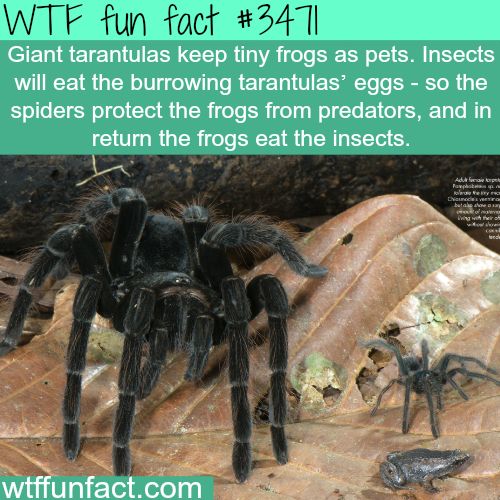
Taking your frog for a walk.

Do tarantulas keep frogs as pets?

Not really. Before we dive into this fascinating relationship, we need to talk about symbiotic relationships. In biology college classes all around the United States, students are learning about the 3 main symbiotic relationships. These relationships are mentioned in almost every biology class I have taken and the topic has haunted me for my entire college career.

Symbiotic might seem like a difficult word and perhaps you’re nervous about learning about it, but it’s likely that you already know the classic examples of these three relationships.

  1. Mutualism (+/+): both organisms benefit from this relationship EXAMPLE: the clown fish and sea anemone
  2. Commensalism (+/0): one organism benefits and the other is neither harmed or benefited EXAMPLE: hermit crabs living in the shells of dead snails (no snails were harmed or helped in the process of making this home)
  3. Parasitism (+/-): one organism benefits and the other is harmed EXAMPLE: a tapeworm living inside of a dog

The relationship that the tarantula Xenesthis immanis has with the frog Chiasmocleis ventrimaculata is a commensalistic relationship, not a domestic one.

Who’s benefiting?

Benefit(s) for the frog: this species of tarantula makes burrows in the ground, which provides protection to the frog

Some have claimed that tarantulas benefit from this relationship because the frogs eat the ants that are trying to snack on the spider’s eggs, but more research needs to be done on this topic to support this argument.

To review: do tarantulas keep frogs as pets?

No, unfortunately, tarantulas do not keep frogs as pets. This particular species of tarantula and frog have a commensalistic relationship with it benefiting the frog.
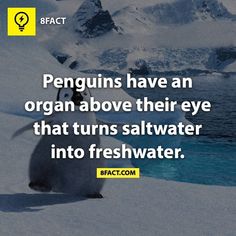
Glands are not organs.

There is no better day to share my first official blog post than on Earth Day! I hope you took the time to step back and appreciate this beautiful planet we are fortunate enough to live on.

Do penguins have an organ that converts seawater into freshwater?

In fifth grade my all-time favorite animal was a penguin. When the Webkinz penguin was released I was the first in line at the local Hallmark and, of course, I named mine Mumble. To this day I still have not seen Happy Feet, but for some reason I had the nerve to name my stuffed animal after the main character. 

Besides being adorable as chicks and adults, penguins have many amazing adaptations that help them thrive in their salt water habitat. A penguin’s diet mainly relies on fish and when they feed, they take in large amounts of salt water. This salt water passes through their supraorbital gland, filtering out the salt and excreting it on the bird’s beak. To get rid of this excess salt, a penguin will sneeze to shake off the mineral. 

So to review: do penguins have an organ that converts seawater into freshwater? 

Kind of.

  1. Seawater is not converted into salt water. The salt is simply (or not that simply) filtered out of the water.
  2. It’s a gland, not an organ that does the filtering.

Worst chemistry minor ever.

Hello fellow science enthusiast! Welcome to my blog, Science My Aunt Shares. Further down in my post I explain the reason behind my blog’s name, but for now I’m going to use this paragraph to introduce myself. My name is Kaitlin and I just graduated from the University of Wisconsin- La Crosse with a degree in biology (biomedical concentration). I have minors in chemistry and professional and technical writing, but I always say that I am the worst chemistry minor ever. Although two-thirds of my degree is rooted in science, I want a career that focuses on my two academic passions, science and writing. Currently, I aspire to be a science writer, or communicator; someone who takes long words like “mitochondria” and “natural selection” and turns them into common phrases like “powerhouse of the cell” and “survival of the fittest.” Writing a blog is one of the many opportunities I have to improve upon my writing and communicate science to the public. Shall we begin?

It feels like half of my friends on Facebook are family members. My feed is constantly flooded with videos, pictures, and memes that my family members feel the need to share. My aunts are by far the most active on Facebook as they seem to comment on every profile picture I’ve had in the past nine years. Although I can always count on them to provide me with support on social media (likes and comments), some of the posts they share about science have me scratching my head. Like do penguins really have an organ that converts seawater to freshwater? Do tarantulas keep frogs as pets? Finally, I have opportunity to research these weird science facts and share what I find with an audience. Be on the lookout for my first official blog post next week!